

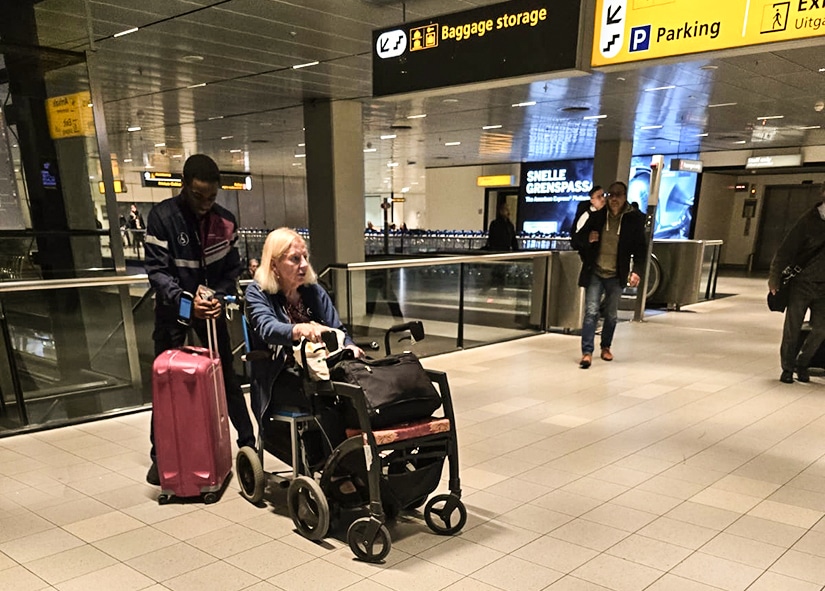
You may wonder: can I take my walker on a plane? The answer is yes and we will explain how.
If you’re planning to travel by plane with a walker or wheelchair, whether it’s manual or electric, the first step is to check the airline’s policies. Did you know you can usually bring your walker or wheelchair, even electric ones, in the airplane’s hold for free? Some airlines also allow lightweight, foldable walkers and wheelchairs to be brought into the cabin as carry-on luggage without needing to check them in.
Walkers and wheelchairs are transported free of charge
Using a walker or wheelchair should not prevent you from traveling by air, as there are incredible destinations around the world to explore. You may have family or friends abroad you’d like to visit, or perhaps you’re simply planning a trip to a distant city and prefer to fly. With the right preparations, you can travel easily by plane, even with your mobility aid.
In general, walkers and wheelchairs are transported in the cargo hold. Items with irregular or oversized dimensions, including strollers, are typically stored in the hold. Most airports consider objects larger than 100 x 75 x 65 cm as oversized, which applies to most walkers and wheelchairs. However, if you have a lightweight, foldable walker or wheelchair within these dimensions, you might be able to bring it into the cabin.
Flying with a rollator: how it works with British Airways, easyJet and Ryanair
If you are flying to or from the UK with British Airways, easyJet or Ryanair, you can take your rollator with you as a mobility aid without paying an extra baggage fee. However, it is best to let the airline know in advance that you will be travelling with a rollator, especially if you also need assistance at the airport. All three airlines recommend arranging assistance at least 48 hours before departure.
With easyJet, you can take up to two mobility aids free of charge, and a walking frame can be taken to the aircraft. If there is space, it may be stored on board; otherwise it will be placed in the hold and returned after landing. British Airways also carries personal mobility aids free of charge, in addition to your normal baggage allowance. Ryanair allows passengers with reduced mobility to take up to two pieces of mobility equipment free of charge.
As procedures can differ depending on the airport and aircraft, always check the website of your airline beforehand whether you can use your rollator up to the boarding gate or need to hand it in at check-in.
Notify the airline when flying with a walker of wheelchair
While it’s not mandatory to inform the airline in advance, it’s strongly recommended to do so both before and after purchasing your ticket. The cargo hold usually has sufficient space to accommodate walkers and wheelchairs. When flying with a walker, notifying the airline ensures smoother handling and prevents surprises. However, requesting special assistance at the airport beforehand can make your journey smoother. For example, if you use a walker, you can request a wheelchair to take you to the boarding gate.
If you’re traveling with an electric wheelchair, keep in mind the following:
- Bring the user manual, which should include technical details, dimensions, and weight.
- A flight certificate for the battery is crucial, as the battery must be disconnected when handed over to the airline.
- Generally, loose batteries (such as lithium, nickel-cadmium, or alkaline) can be safely transported in hand luggage if adequately protected against short circuits.
Can you bring a walker to the gate?
Sometimes, you’ll need to hand over your walker or wheelchair at check-in, meaning you won’t have it with you beyond that point. If walking to the boarding gate is challenging, airport assistance can provide a wheelchair for you to use. Upon arrival, a new wheelchair will be available for you to get to the baggage claim area.
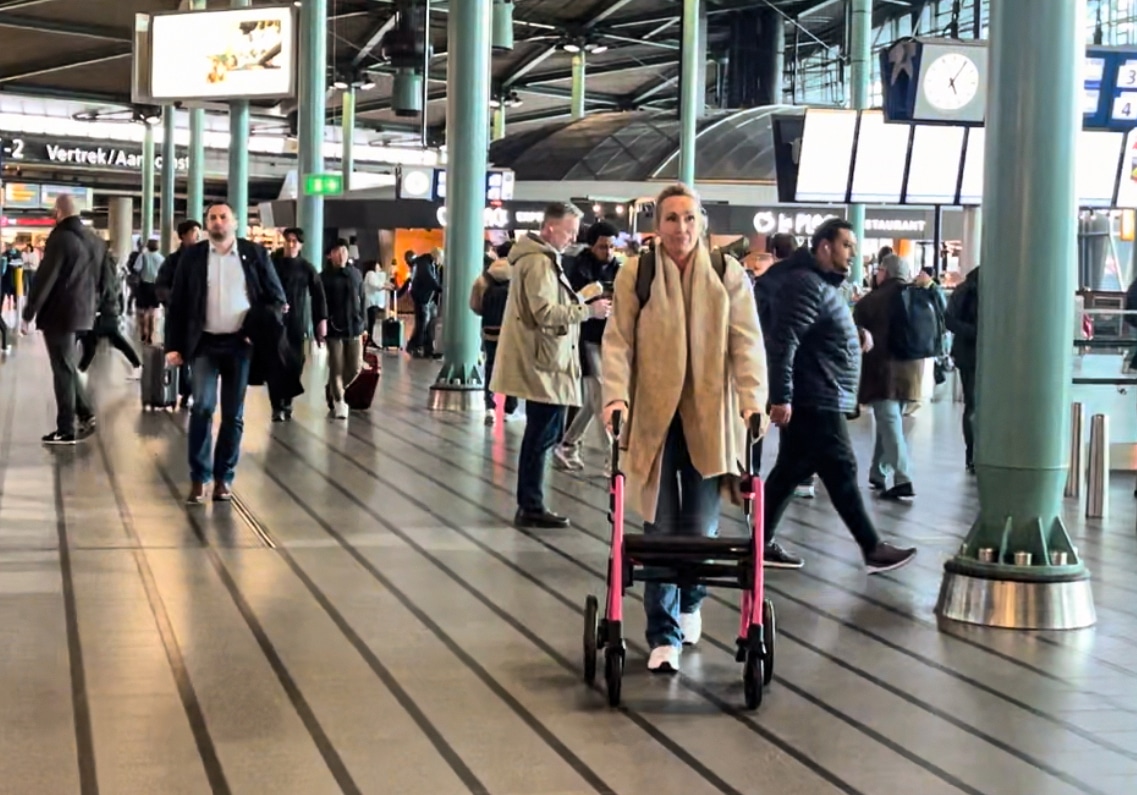 However, many airports allow walkers to be brought to the boarding gate, where staff will store them in the hold and return them to you upon landing. This makes flying with a walker more convenient and stress-free.
Using a protective travel cover for your walker or wheelchair can prevent scratches or damage while in transit. Additionally, purchasing travel insurance for your mobility aid is a practical option in case of serious incidents or loss.
Most airlines will cover urgent replacements, but it’s good to confirm this with your travel agency or a company specializing in accessible travel.
Flying with a wheelchair: best models for air travel
Any walker or wheelchair, including electric ones, can be transported in the hold. However, lightweight, foldable models are less cumbersome. For those flying with a walker or wheelchair frequently, a compact and portable model is ideal. For frequent travelers, a convertible walker-wheelchair like the Rollz Motion, which combines compact, lightweight features with functionality, can be an excellent choice. Models like these simplify transportation and reduce the hassle of traveling with multiple mobility aids.
Do you prefer to travel with a more lightweight walker and you don’t need a walker and wheelchair combination? In that case, the Rollz Air is the right solution, as the carbon rollator is ultra lightweight and easy to fold and take with you on an adventures abroad.